Happer: Why Earth's Temperature Won't Rise Even if CO2 Doubles or Triples
The Greenhouse Effect from CO2 levels is already"maxxed-out." A rise to 800 ppm or 1600 ppm of atmospheric CO2 (up from the current 400 ppm) would barely effect Earth's current temperatures

From “How to Think About Climate Change” from Watts Up With That
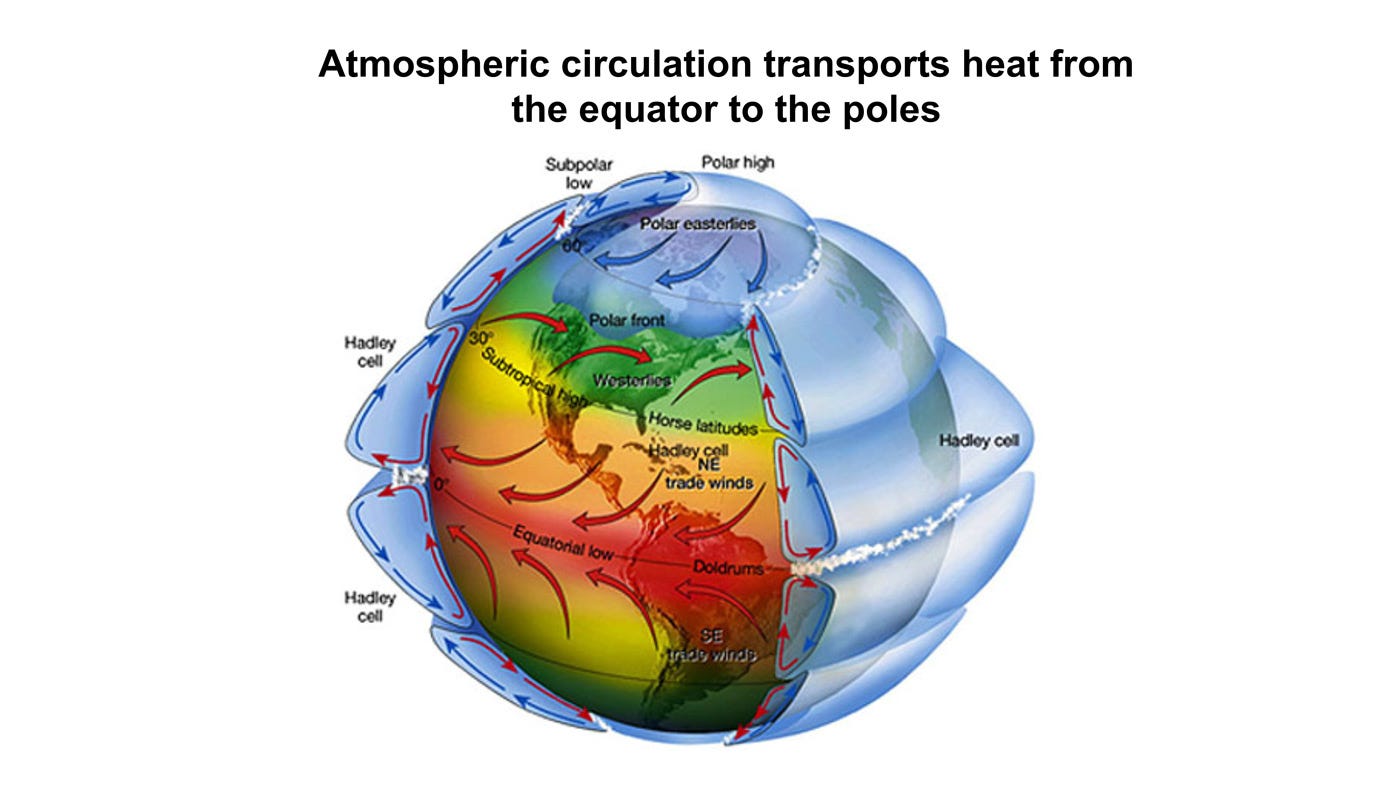
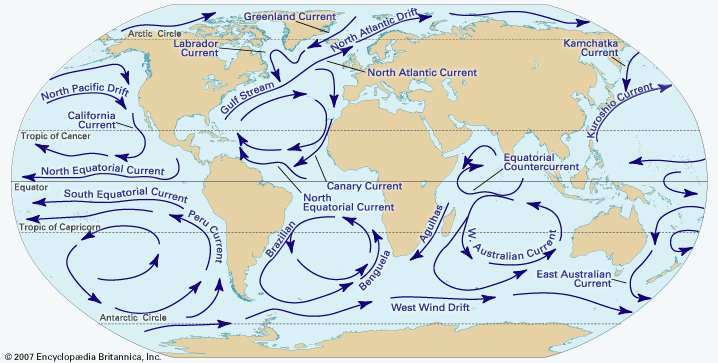
Here’s a few figures to remind us of the very large scale circulation of both air and ocean water that result in an earth’s temperature equilibrium (not showing seasonal changes). And none of these figures shows all of the effects of “weather,”, ie., more localized and transient thunderstorms, fronts and cyclones that hoover-up heat at the surface and shunt it to the upper atmosphere. “Weather” protects us enormously. But I don’t believe anyone can model it!
The Earth’s Daily Energy Balance
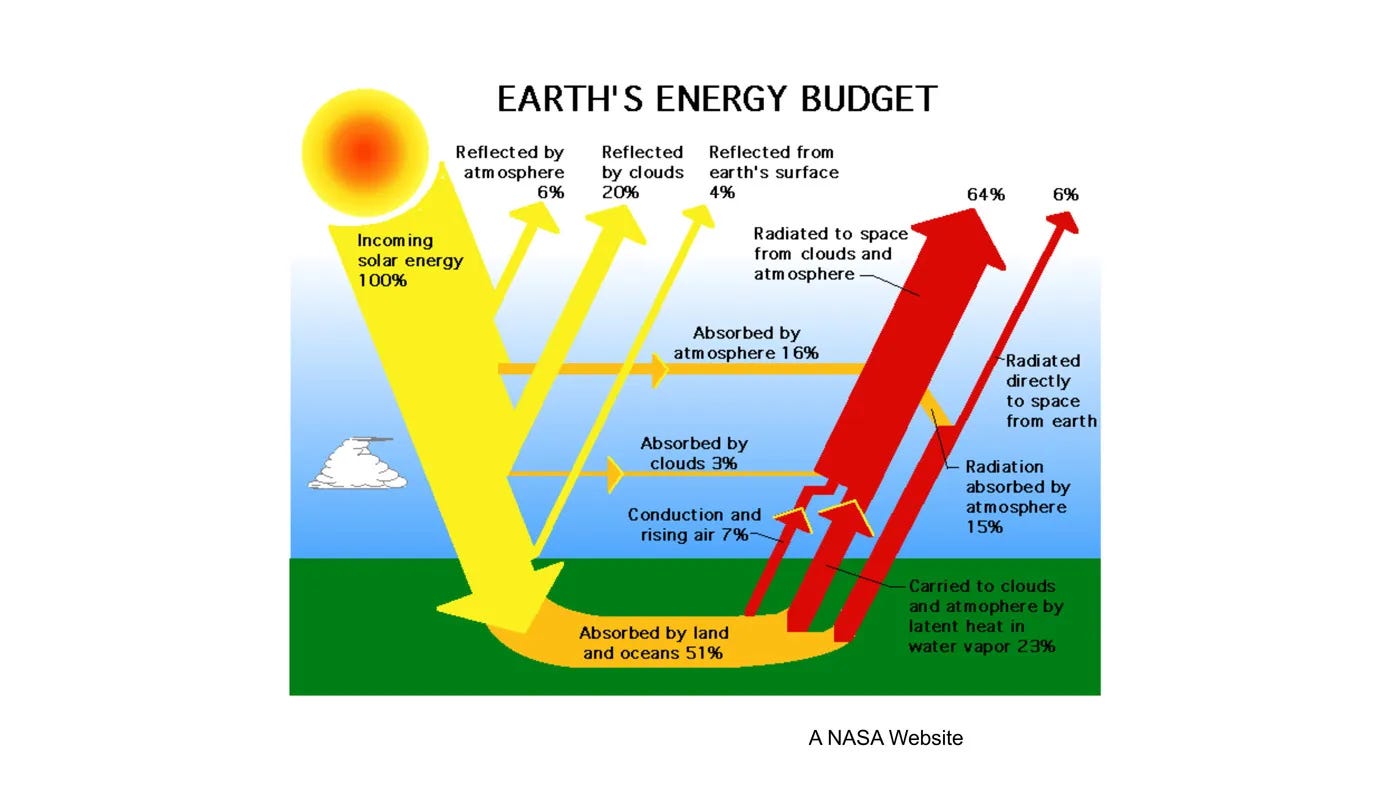
The graphic below, Fig 3, shows a heat balance of incoming radiation (heat) in YELLOW from the sun versus the Earth’s heat losses through radiation of heat back into space (RED). You can add up the balance on a daily basis: what comes in is also re-transmitted out.
Only about 51% of the sun’s incoming radiation from the sun makes it to where people live; ie., on the surface of the planet. Much of it is absorbed by the atmosphere itself and re-radiated back into space.
Then, at night, lower frequency radiation sends all of the day’s gain in energy back into space. Water vapor, Ozone and trace carbon dioxide are the main greenhouse gases retaining (blocking) some of the re-radiated heat. It’s these gases that work to keep the Earth from cooling TOO MUCH at night—giving us a nice climate equilibrium. Without the greenhouse gases the Earth would literally be in a permanent ice age, a glaciated snowball.
We’ll show at the end, that the absorption by earth’s current CO2, Water vapor, Ozone levels are blocking re-radiation of heat energy are already “maxxed-out”at current levels so that the heat retention at night is also “maxxed-out”— more CO2 in the atmosphere WOULD NOT warm the Earth (more on that below).
Atmospheric Components That Block Both Incoming and Outgoing Radiation
Now we get to the complicated part of radiation and re-radiation as shown in the chart below (Fig 4). The incoming sun’s heat is shown below in RED—mostly visible (sun)light. Only about 51% of the sun’s energy reaches where we live (from above). The BLUE Area is lower frequency/energy radiation to outer space (much of it at night).
The frames below the colored incoming and outgoing energy show the “absorption” by the various greenhouse components in the Earth’s atmosphere and their effects are combined in the “Total Absorption and Scattering” frame. You can see that water vapor in air is doing the most to interrupt incoming AND outgoing heat. Water vapor is the biggest greenhouse gas. But water vapor, nitrogen, argon, CO2 and oxygen ozone are blocking some incoming radiation and re-radiation at night.
Water vapor, Ozone/O2 and CO2 helps prevent TOO MUCH heat escaping at night—keeping us in a nearly perfect daily temperature range. But it’s water vapor that does the most. CO2 plays a much smaller role.
Think of desert climates that are very dry (much less water vapor). At night, those places can get very, very cold AND very hot in the day. It shows how air’s water vapor mostly stabilizes our environment’s temperature. Carbon dioxide does some too, but it’s a smaller effect.
Carbon dioxide mostly affects the night-time re-radiation and only marginally adds to the effect of water vapor in retaining heat at night.
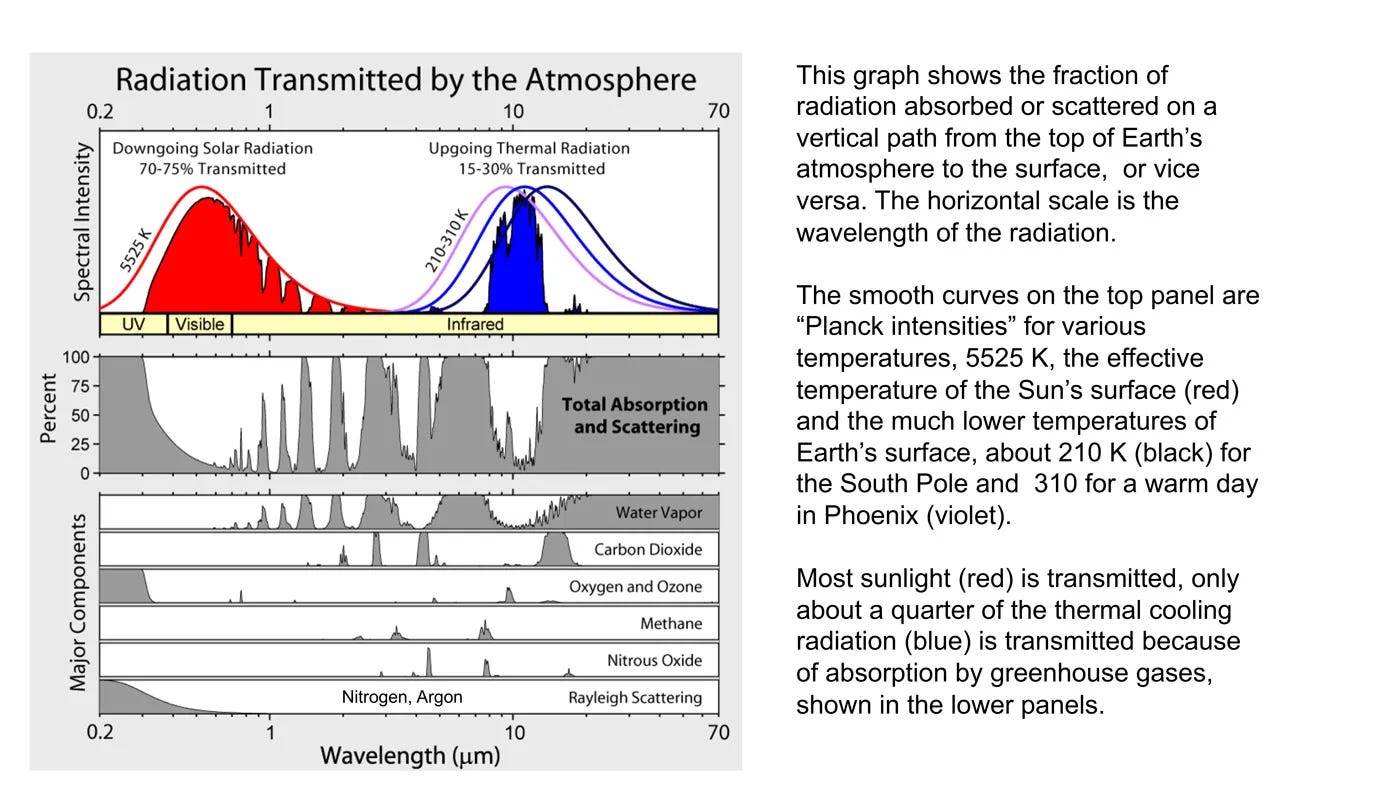
There’s a lot of blocking of radiation in total. The amount that makes it through FROM the sun is the RED area at the Left of the 1st Frame. The amount of energy re-radiated to space at night is the BLUE area at about 11 micro-meter frequency.
It’s mostly Water Vapor, Oxygen/Ozone and some CO2 that mostly blocks the re-radiation of the day’s solar energy gain and prevents Earth’s temperature from plunging at night (like a desert). Without this effect, the Earth would be much colder!
Without ANY Greenhouse Gases, the Earth Would be 50 deg F Colder!
Refer to to Figure 5 below. It’s same “blocking effects” of all the greenhouse gases shown in Figure 4.
The real “curve” is best described instead by a jagged black line. It’s significantly different than the smooth, theoretical modeling in blue.
The first big radiation block is caused by CO2 absorbing the re-radiation that would otherwise cool the Earth (Area = 307 Watts/m2) at night (at about 700 on Fig 5).
The green line shows the isolated effect of ZERO CO2 (0 ppm) in re-radiation. Much more heat would leave the Earth especially at night at 0 ppm CO2. This would induce seriously colder conditions on the planet—nearly 50 deg F colder!
The second big radiation block is absorption due to Ozone or O3/ (Area = 277 Watts/m2)—another greenhouse gas (at about 1100 on Fig 5).
The important point here is the red line (versus the actual black jagged line) at 700 units. This is what Earth would radiate to space if you were to double our CO2 concentration from today’s value of 400 ppm to 800 ppm.
If you double the amount of CO2, you just go from the black curve to the red curve, and you can barely see a difference. The re-radiation at night hardly changes. The Earth’s equilibrium temperature barely changes!
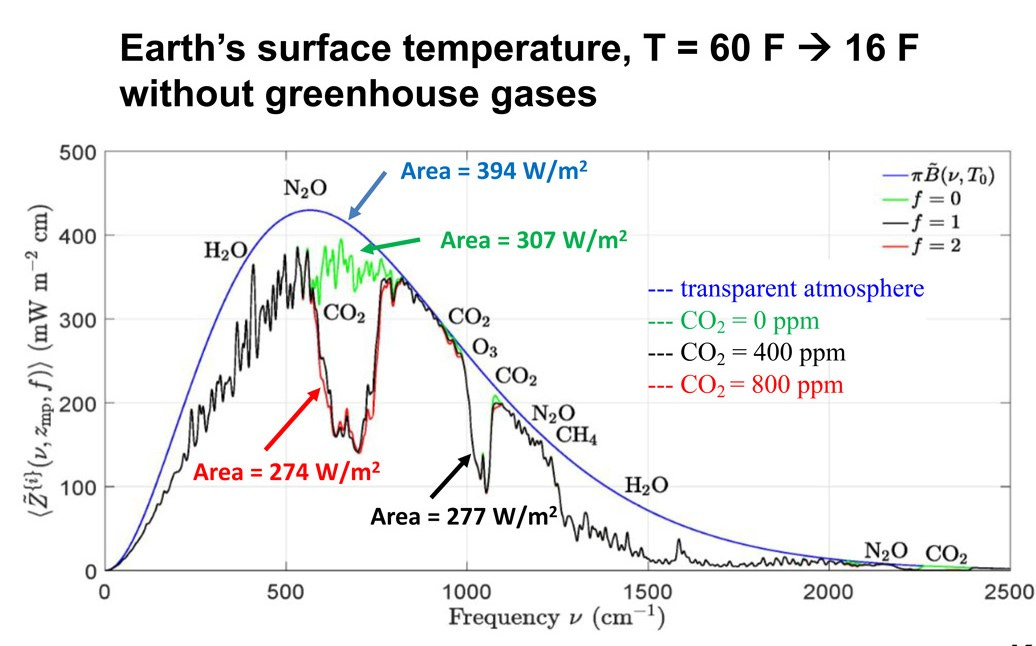
The important point here is the red line. If you double the amount of CO2 to 800 ppm, you don’t change much of CO2 blocking. It’s already “maxxed-out” and you can barely see a difference.
Happer must be correct as the rise in Earth’s temperatures is much lower than expected by many “scientists”. Check out the graph below showing the climate of the Earth is barely changing (compared to theoretical models):
